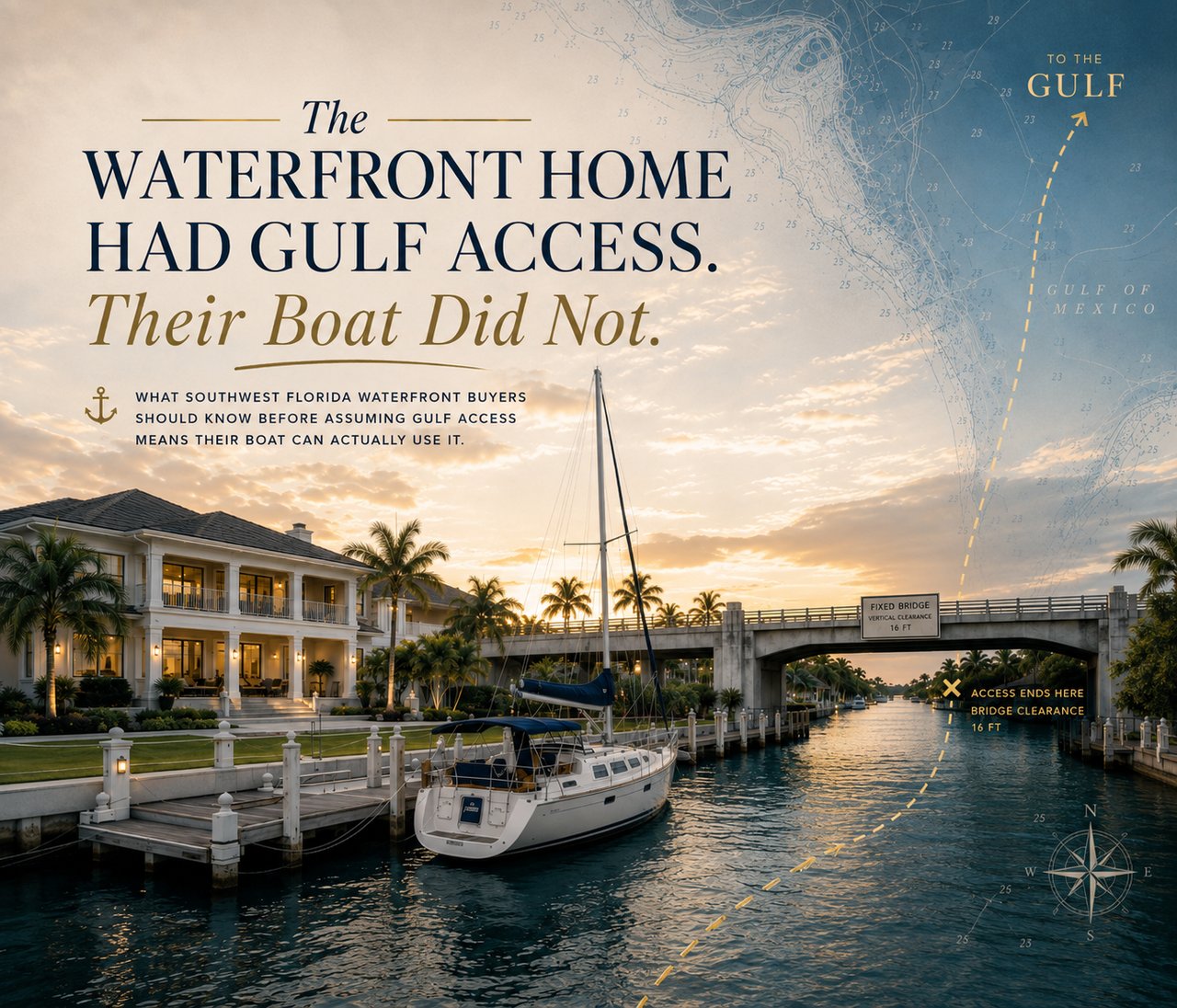
The Waterfront Home Had Gulf Access. Their Boat Did Not.
What Southwest Florida waterfront buyers should know before assuming “Gulf access” means their boat can actually use it.
Quick Answer: What Is the Difference Between Gulf Access and Sailboat Access in Southwest Florida?
“Gulf access” generally means there is a navigable water route from the property toward the Gulf of Mexico, but that route may include fixed bridges, shallow areas, long canal runs, slow-speed zones or other restrictions. “Sailboat access,” sometimes marketed as “direct access,” generally refers to a route without fixed bridges that would prevent a tall-masted vessel from reaching open water.
Neither term should replace verification of the actual boating route.
Gulf access tells you where the water goes. It does not necessarily tell you whether your boat can go with it.
The Dream Waterfront Home
Imagine the Harrisons. They had spent years picturing retirement in Southwest Florida: coffee overlooking the canal in the morning, weekends taking their 38-foot sailboat toward Sanibel, Captiva and the Gulf, and the freedom to step out the back door and onto the water.
Then they found the house.
It had a wide canal view, a private dock, plenty of waterfront appeal and, most importantly, the words Gulf Access in the listing. Their sailboat fit beautifully behind the home, so everything seemed perfect.
Until they traced the route toward open water.
A fixed bridge stood between their backyard and the water they actually wanted to reach. Their boat fit the dock and it fit the canal, but the mast could not clear the route.
The Harrisons are fictional, but the issue is very real. When buying a canal, riverfront or Gulf-access home in Fort Myers, Cape Coral, Bonita Springs or another Southwest Florida boating community, the dock behind the house is only the beginning.
The real question is what happens after you leave it.
“Gulf Access” Is a Route, Not Just a Property Feature
Real estate search filters make waterfront buying look deceptively simple: waterfront, dock, boat lift, Gulf access. But two properties can both legitimately be described as Gulf-access homes and provide completely different boating experiences.
One may offer a relatively short route to the Caloosahatchee River, Estero Bay or another major waterway. Another may require navigating miles of residential canals, fixed bridges and reduced-speed areas before reaching larger water.
Both may technically have Gulf access.
For the person actually using the boat, they may be very different properties.
That is why one of the first questions a serious boating buyer should answer is not simply, “Do I want Gulf access?”
It is:
“What boat do I own, and what kind of boat might I own five years from now?”
That question can completely change the home search.
One Bridge Can Change Everything
If your vessel has a hardtop, tower, radar arch, antennas or mast, you need to know its air draft, meaning the height from the waterline to the boat’s highest fixed point.
Now imagine there are four bridges between the home and open water. Your boat clears the first three comfortably, but the fourth is too low.
The first three no longer matter.
The lowest fixed bridge on the route can determine whether the property works for your boat at all.
Water level also matters. Changes in tide can affect both the amount of water beneath the vessel and the amount of clearance available overhead. Higher water may provide more depth but less room beneath a bridge. Lower water can create more bridge clearance while reducing depth below the boat.
This is where the distinction between Gulf access and sailboat access becomes especially important. In Southwest Florida real estate, “sailboat access” is commonly used to describe a route without low fixed bridges, but it should never be treated as a substitute for verifying the actual route.
The boat does not care what the MLS says. It cares whether it fits.
Gulf Access vs. Sailboat Access
A property marketed as Gulf access generally has a navigable route toward the Gulf, but that does not automatically mean there are no bridges, the water is deep enough for every vessel, the trip is short or the existing lift is suitable for your boat.
For many center consoles, pontoons, deck boats and lower-profile vessels, bridge-restricted Gulf access may work beautifully.
Sailboat access, sometimes called direct access, generally indicates that fixed bridges do not obstruct the route to open water. That can also matter to larger motor yachts and tall flybridge vessels.
But even a bridge-free route does not answer every question.
Depth, tides, channel conditions, dock configuration and travel time still matter.
The MLS description should start the conversation, not finish it.
What Is Under the Boat Matters Too
Buyers naturally focus on whether they can fit beneath a bridge, but the depth below the boat can be just as important.
A vessel’s draft is the distance it extends beneath the waterline. A shallow-draft center console and a deeper cruiser may use the same canal and have very different experiences.
Depth can vary at the dock, farther into the canal and throughout the route toward open water. Tides, sedimentation and dredging can all affect navigability.
So instead of asking only:
“How deep is it behind the house?”
Ask:
“Is there adequate depth for my boat along the entire route I intend to use?”
That is a much more useful question.
Five Miles by Boat Is Not Five Miles by Car
A waterfront home can look remarkably close to open water on a map and still involve a lengthy boating trip.
Residential canals may wind through multiple neighborhoods. Slow-speed or minimum-wake areas can add time. Weekend traffic and navigation conditions can change the experience even further.
For one owner, cruising through the canals may be part of the appeal. Another may want to lower the boat and reach larger water as quickly as possible.
Neither preference is wrong.
But they are very different lifestyles.
For a serious boater, “How many minutes to open water?” may matter more than “How many miles?”
When considering a property, trace the actual route rather than relying on straight-line distance.
Be Careful With Old Information About Cape Coral Waterways
Waterfront infrastructure changes, which means older blog posts, boating forums and neighborhood descriptions may no longer tell the full story.
Cape Coral provides a good example. For years, buyers researching properties in southwest Cape Coral encountered references to the Chiquita Boat Lock. The City completed removal of that lock in 2025, meaning older descriptions of that route are now outdated.
That is an important lesson beyond one particular waterway.
Locks can change. Bridges can change. Channels can be dredged. Storms can alter waterways and navigation conditions.
Verify today’s route for today’s boat.
The Boat Fits. Does the Lift?
An existing boat lift is certainly valuable, but it is not automatically suitable for the buyer’s vessel.
Lift capacity, loaded boat weight, beam, bunk configuration, piling placement, lift width, water depth and equipment condition all matter. A lift that worked perfectly for the seller’s boat may be undersized or configured incorrectly for yours.
Rather than asking only:
“Does the house have a boat lift?”
Ask:
“What was this lift designed to hold, and will it safely accommodate my boat?”
That distinction can prevent a very expensive surprise after closing.
Don’t Forget the Seawall
The boat and the view usually get the attention. Meanwhile, the structure holding the shoreline in place may receive far less consideration.
The seawall deserves due diligence of its own.
Depending on the property, buyers may want an appropriately qualified marine professional to evaluate visible cracking, movement, separation, cap condition, soil loss and previous repairs.
Permit history can also help tell the story of docks, lifts, seawalls and other waterfront improvements.
A beautiful waterfront setup is much more reassuring when the paperwork tells the same story as the property.
Four Waterfront Features Worth Investigating
Waterfront Feature | What Buyers Should Investigate |
|---|---|
Boat Lift | Capacity, beam, bunk setup, piling configuration, water depth, condition and suitability for the loaded vessel |
Seawall | Cracking, movement, cap condition, soil loss, prior repairs and whether specialized inspection is appropriate |
Dock & Marine Structures | Permit history, dimensions, condition, electrical service and previous modifications |
Canal & Access Route | Depth, bridges, tides, dredging history, slow-speed areas and realistic travel time |
The goal is not to turn every waterfront buyer into a marine engineer.
The goal is to know which questions need to be answered before the property becomes yours.
Who Keeps the Canal Deep Enough?
Canals naturally accumulate sediment, so serious waterfront buyers should also ask who is responsible for dredging and maintaining navigable depth.
Cape Coral, for example, operates a large canal-dredging program designed to address sedimentation and maintain waterways. But that does not mean every shallow area beside every private dock automatically becomes a municipal responsibility.
For a particular property, buyers should investigate whether dredging has occurred recently, whether future projects are planned, whether private dredging could become necessary and whether community or governmental assessments might apply.
It is another example of information that is much nicer to discover during due diligence than after the propeller starts finding the bottom.
Your Dock Is Only the First Part of the Journey
Most buyers inspect the house. Savvy waterfront buyers also examine the dock, lift and seawall.
Serious boaters need to go one step farther.
They need to investigate everything between the dock and open water.
The dock may be perfect. The seawall may be solid. The lift may accommodate the boat. Yet the property can still be wrong for the owner because of a fixed bridge, shallow section, narrow channel, long reduced-speed run or inconvenient travel time farther down the route.
That is why Gulf access should be viewed as a boating route, not simply a real estate amenity.
Buy for the Boat You May Own Tomorrow
Buyers should also think beyond the vessel they own today.
A center console may clear every bridge comfortably now, but a future cruiser, sailboat or taller vessel could turn the same waterfront location into a limitation.
For one buyer, paying more for fewer bridge restrictions and quicker access to open water may make sense. Another may happily accept a longer canal ride because they value the house, view or price more.
There is no universally best Gulf-access property.
There is only waterfront access that matches the way you intend to use it.
Questions Waterfront Buyers Should Ask Before Closing
Before purchasing a Gulf-access home in Fort Myers, Cape Coral, Bonita Springs or another Southwest Florida boating community, buyers should be able to answer:
- What is the exact boating route from the dock to the river, bay or Gulf?
- Are there fixed bridges, and what is the limiting clearance?
- How does that clearance compare with the boat’s air draft?
- Is there sufficient depth for the boat’s draft along the intended route?
- How long does the trip realistically take after slow-speed areas are considered?
- Does the existing boat lift safely accommodate the vessel?
- What is the condition and permit history of the dock, lift and seawall?
- Who maintains or dredges the canal and access channel?
- Would the property still work if the owner eventually bought a larger boat?
Those questions turn a vague marketing phrase into something far more useful:
a boating plan.
Frequently Asked Questions About Southwest Florida Gulf-Access Homes
Does Gulf access mean there are no bridges?
No. A Gulf-access property can have a navigable route toward the Gulf while still having one or more fixed bridges along the way.
Is sailboat access better than Gulf access?
Not automatically. It depends on the vessel and the buyer’s priorities. Sailboat access is especially valuable for boats requiring greater overhead clearance, but depth, dock suitability and travel time still need to be investigated.
How do I know whether my boat will fit under a bridge?
Know the boat’s air draft and verify the limiting bridge clearance along the actual route. Water level can affect available clearance, so close margins should never be based on guesswork.
Can I assume an existing boat lift will fit my boat?
No. Capacity, dimensions, bunk configuration and condition should be compared with the buyer’s specific vessel, including fuel, equipment and gear.
Should I inspect the seawall when buying a waterfront home?
The seawall is an important part of waterfront infrastructure. Depending on its age and condition, buyers may want an evaluation from an appropriately qualified marine or structural professional.
Is Cape Coral’s Chiquita Boat Lock still part of the boating route?
No. The City of Cape Coral completed removal of the Chiquita Lock in 2025, which is one reason buyers should be cautious about relying on older online information.
Change the Question
When touring Fort Myers Gulf-access homes, Cape Coral canal homes, Bonita Springs waterfront properties or other Southwest Florida boating communities, do not stop with:
“Is this Gulf access?”
Ask instead:
“Can my particular boat travel from this particular dock to where I actually want to go safely, comfortably and conveniently?”
That one question can change which neighborhoods you consider, what waterfront features matter most and how much one property may be worth compared with another.
Because buying the waterfront home is only half the equation.
The other half is making sure your boat can enjoy it too.
The Harrisons and their transaction are fictional and created for educational purposes. Waterway depths, bridge clearances, tides, navigation conditions, regulations, permits and boating restrictions can change. Buyers should independently verify current conditions and marine suitability for their specific vessel with applicable governmental agencies and appropriately qualified marine, surveying, engineering and inspection professionals. This article is for general informational purposes and is not legal, engineering, insurance or marine-navigation advice.
Information reviewed: August 2026.