If a builder closes every home at full asking price and the owner two streets over, in a home built the same year, closes at five percent less, what does the list price on either listing actually tell you? In Verdana Village right now, the answer is not what most buyers assume.
The Same Community, Two Different Negotiations
Look at a single 120-day window of closings in Verdana Village earlier this year. Builder transactions, 22 of them, closed at full asking price. Resale transactions in the same stretch, 29 of them, closed at 95.4% of list with a median of 57 days on market. Same gated community, same amenity package, same builders behind nearly every home on the street. One group of sellers held their number. The other gave up roughly 5% to get to closing.
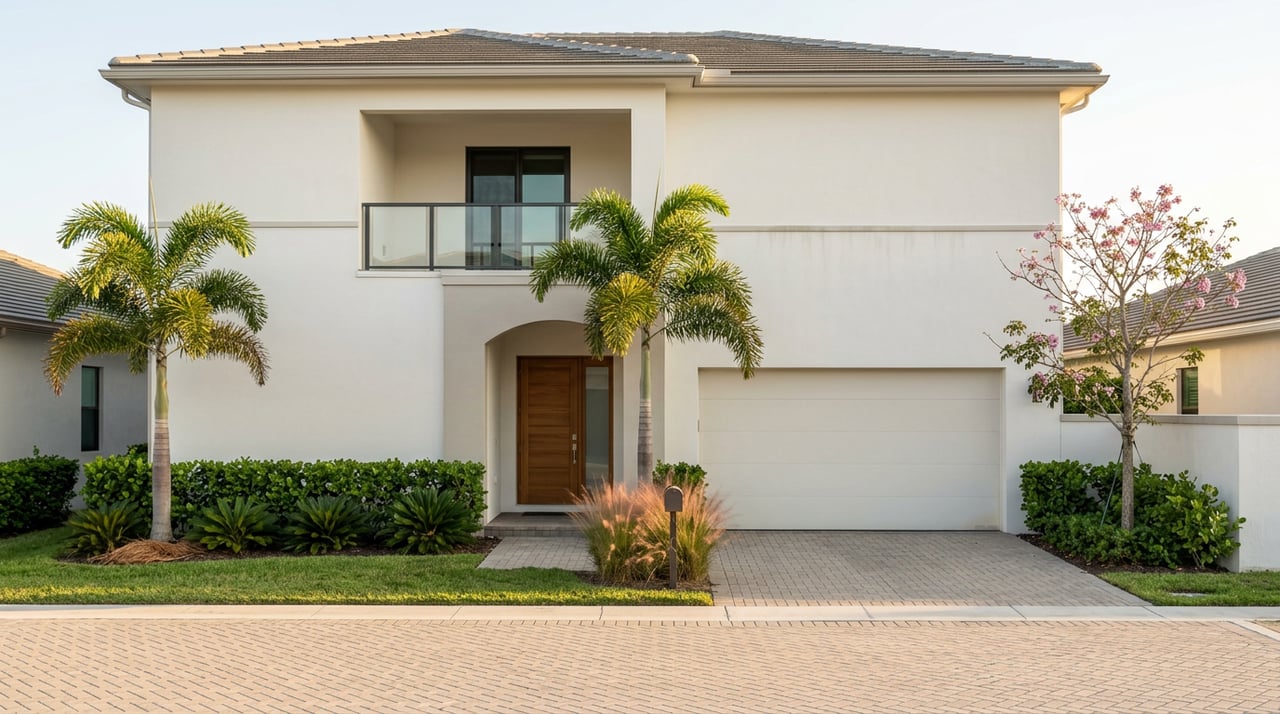
That gap would make sense if the resale homes were older, dated, or competing against a fresher product. They are not. Every home in Verdana Village was built between 2022 and 2026. A resale listing here is not a 15-year-old house up against new construction. It is a three-year-old house up against a four-year-old one, and sometimes up against a home built the same calendar year. The condition story does not explain the gap. The negotiation structure does.
What Three Months of Reports Show
Verdana Village's inventory picture moved fast in early 2026. Here is how the community's own numbers shifted across three consecutive monthly market reports:
| Report month | Months of supply | Sold-to-list ratio | Median closed DOM |
|---|---|---|---|
| February 2026 | 2.6 | 95.4% (resale) / 100% (builder) | 57 days |
| March 2026 | 2.8 | 47% of closings at or above ask | 24 days (3+den segment) |
| April 2026 | 4.5 | 97.4% | 82 days |
Supply nearly doubled in about two report cycles, from 2.6 months to 4.5 months. If that were the whole story, you would expect sold-to-list ratios to soften as sellers competed harder for fewer buyers. Instead the ratio held in the mid-to-high 90s the entire time, and by April it was the strongest in Estero that cycle. Days on market stretched from 57 to 82, but the discount off asking barely moved. That combination, more time to sell paired with a stable price outcome, means buyers were taking longer to decide, not gaining leverage once they did.
Why the Builder Doesn't Bend
A builder's price sheet is not really a negotiating position. It is closer to a menu. The builder is not going to shave $30,000 off a base price because that number sets the comp for every remaining lot in the phase. What moves instead are the incentives layered on top: rate buydowns, closing cost credits, design center upgrades folded into the deal. From the outside, that looks like a home selling at full price. From the buyer's side, the actual cost of ownership can be lower than the sticker suggests, just not in a way that shows up in the sold-to-list ratio.
A resale seller in Verdana Village does not have that lever. They cannot manufacture a rate buydown out of thin air, and they are pricing against a builder down the street who effectively never discounts on paper. So the resale seller's only real tool is the number itself, and the market has been pricing that difference at roughly 5% for months.
On a $650,000 home, five percent is $32,500. That is not a rounding error, and it is not explained by paint color or landscaping.
The Number That Doesn't Show Up on the Listing Sheet
The list price gap is the visible friction. There is a second one that only surfaces once a contract is written. Verdana Village sits inside a Community Development District, and the CDD assessment is not uniform across the community. Documented figures for homes here range from roughly $1,319 to $2,058 a year depending on which section and phase the home sits in, collected as a non-ad valorem line on the property tax bill rather than through the HOA statement.
On top of that, HOA dues run in the $329 to $385 a month range depending on section, billed quarterly. Buyers should also expect a one-time capital contribution near $1,500, a one-time transfer fee around $1,000, and an annual food and beverage minimum of about $480 tied to the amenity campus.
None of that appears in the headline list price on either a builder contract or a resale listing. Two homes that look identical on paper, same floor plan, same square footage, same asking price, can carry meaningfully different annual carrying costs depending on which phase they were platted in. That is not a detail worth discovering after closing.
What This Means If You're Comparing Two Listings
Put the pieces together and the practical guidance is straightforward. When you are cross-shopping a builder's inventory home against a resale listing in Verdana Village, you are not comparing two prices. You are comparing a fixed number with incentives attached against a negotiable number with none, on top of a CDD line that can differ by hundreds of dollars a year depending on the section. The April 2026 numbers make the stakes concrete: the median list price across active homes that month was $654,500, and the homes that actually closed sold for a median of $613,000, a $41,500 gap between what sellers asked and what buyers paid. That is the kind of number a buyer needs before writing an offer, not after.
This is exactly the kind of detail that gets missed when a transaction is treated as a single number on a portal. Confirming which phase a home sits in, what its actual CDD assessment is, and whether a resale seller has room to move before you counter a builder's incentive package is the difference between a smooth closing and a surprise on the settlement statement.
FAQ
Does the builder's price include the CDD and HOA fees? No. Both are separate from the base price and are disclosed at contract, not baked into the sticker number you see advertised. Confirm the specific section's CDD assessment before comparing two homes on price alone.
Why did days on market nearly double between February and April 2026 while sold-to-list stayed strong? Buyers were taking longer to decide, but well-priced homes were still converting close to asking. Longer timelines reflected more deliberate shopping, not weaker demand or falling prices.
If all the homes are recent construction, is there really a meaningful difference between new and resale? The physical difference is minor since nothing in the community predates 2022. The meaningful difference is structural: builders hold price and negotiate through incentives, while resale sellers negotiate through the price itself, which is why the sold-to-list gap exists even between homes just a year or two apart in age.
If you are weighing a builder contract against a resale listing in Verdana Village, or trying to figure out what a specific phase's CDD assessment actually adds to your monthly cost, that is exactly the kind of detail worth a conversation before you make an offer. Peggy Lotz has spent decades untangling exactly this kind of transaction friction for buyers and sellers across Estero. Let's Talk — Schedule Your Personalized Consultation.