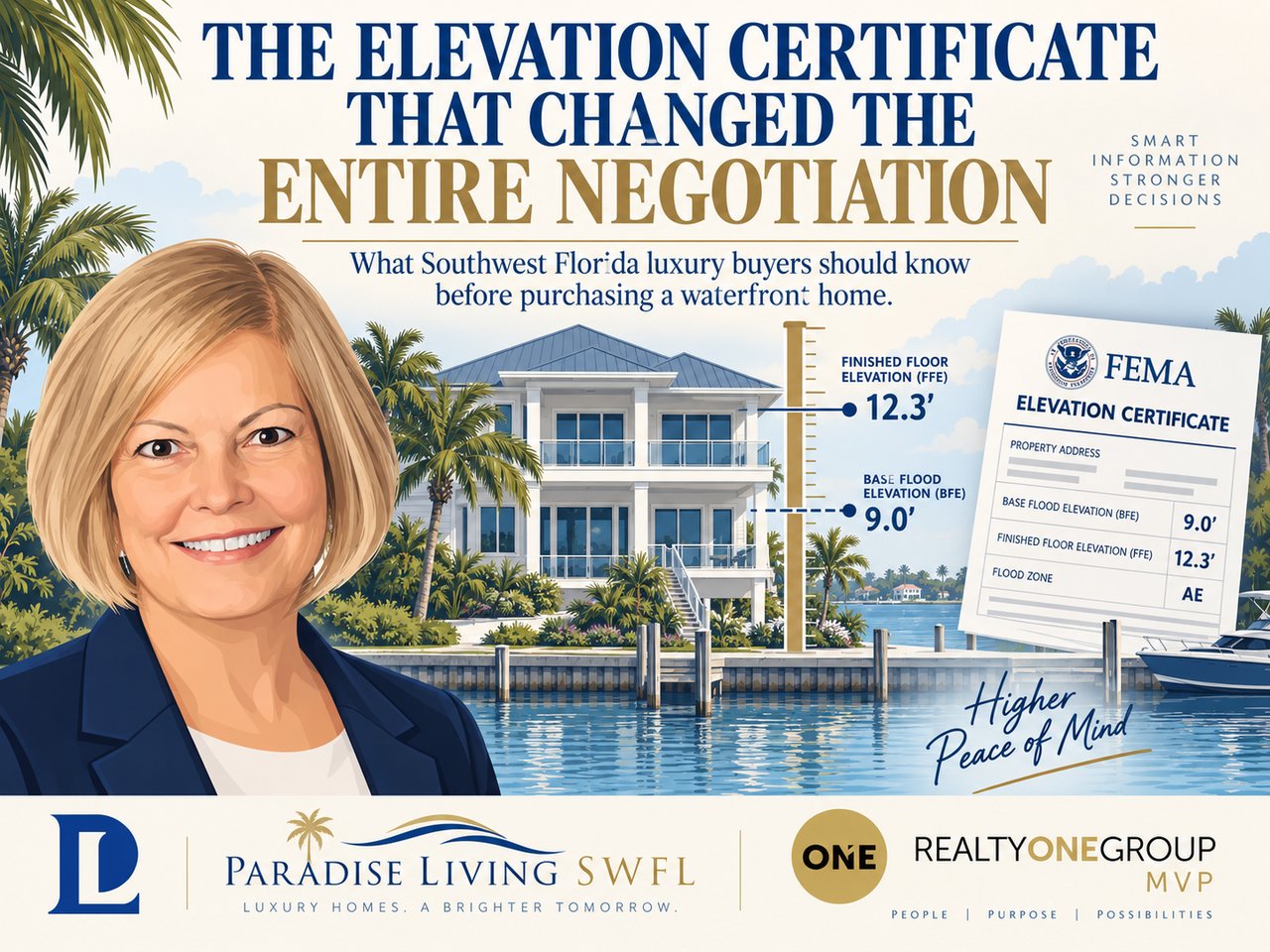
Why Southwest Florida luxury buyers should understand how the home itself sits within the flood zone before deciding what the property is really worth.
Quick Answer: What Does an Elevation Certificate Tell a Florida Homebuyer?
A FEMA Elevation Certificate records property-specific information about a building, including relevant floor elevations, the grade around the structure, flood-zone and Base Flood Elevation information, building configuration, flood openings, and the elevation of certain machinery and equipment.
That gives a buyer something a flood-zone label cannot: measurements showing how the actual house sits relative to the mapped flood elevation.
An Elevation Certificate does not predict whether a property will flood. It is not a structural inspection, an insurance quote, or a replacement for a boundary survey. Under FEMA's Risk Rating 2.0, it is also no longer universally required simply to purchase an NFIP flood policy. An owner can still provide one to an NFIP insurer to see whether the more specific elevation information affects the rate.
For a waterfront buyer, that changes the conversation considerably.
Instead of stopping at “What flood zone is this house in?”, we can ask “How is this particular house actually positioned within that flood zone?”
The House Looked Elevated. They Assumed That Settled It.
Michael and Andrea had already started placing furniture in their heads.
The Fort Myers Gulf-access home had nearly everything they wanted. It had been thoughtfully renovated, with impact glass, a newer roof, an expansive pool deck, outdoor kitchen, dock, and enough room for the boat they planned to buy after settling in.
The main living level sat a full flight of stairs above grade. Beneath it were the garage and a finished bonus area with tile floors, a wet bar, and doors opening toward the pool.
They were paying cash.
Then Michael noticed Zone AE in the property information.
He asked about it, looked at the elevated living level, and decided he wasn't particularly concerned. No mortgage lender would be requiring flood insurance, and visually the house certainly appeared elevated.
During due diligence, we located an Elevation Certificate.
The good news was that the main living floor really was elevated. The certificate gave us actual numbers instead of impressions.
Then we looked at the lower level.
The original certificate described that area differently from the beautifully finished space Michael and Andrea had just toured. It also showed that some equipment serving the property sat considerably lower than the main living area.
Nothing on the certificate said the home was unsafe. Nothing said it would flood.
It simply raised questions nobody had thought to ask during the showing.
That was when the flood zone stopped being the story. The house itself became the story.
Michael and Andrea are fictional, but the situation reflects the kind of due diligence that matters with older and renovated waterfront homes throughout Southwest Florida.
A Flood Zone Describes the Mapped Hazard. The Certificate Describes the House.
This distinction sounds simple, but it changes how you evaluate waterfront property.
A FEMA Flood Insurance Rate Map identifies areas according to mapped flood hazards. An Elevation Certificate records measurements and characteristics of a particular building on that land.
That is why two neighboring homes can both be in Zone AE and still be very different properties from a flood-risk standpoint.
One may have been constructed decades ago close to grade. The home beside it may have been built later on an elevated foundation. Their living floors can sit at different elevations. Their mechanical systems may be positioned differently. One may have a compliant garage or storage enclosure below the living area, while another may contain later improvements that deserve a permit review.
Cape Coral's own flood-information system makes this distinction clear. A homeowner can look up the property's flood zone and Base Flood Elevation, then separately search for Elevation Certificates containing information about the structure.
Same canal. Same flood zone. Potentially very different houses.
What Is the Base Flood Elevation?
The Base Flood Elevation, usually called the BFE, is the elevation associated with a flood that has a 1% chance of being equaled or exceeded in any given year. FEMA shows BFEs on its maps for detailed flood zones including AE and VE.
That 1% probability is why you sometimes hear the phrase “100-year flood,” although the phrase can be misleading. It does not mean such a flood occurs only once every hundred years.
Once we know the applicable BFE, the Elevation Certificate gives us surveyed elevations for relevant parts of the building. Now we can compare the house with the mapped flood elevation rather than judging it by how high the front steps look from the driveway.
That comparison is useful.
It still isn't a guarantee.
A home above BFE can flood during a storm that exceeds the mapped event, from rainfall, drainage problems, storm surge, or other conditions. A home below or closer to BFE is not automatically a bad purchase either. The information needs context.
Elevation gives us evidence, not certainty.
What Do Zone AE, VE, and X Actually Mean?
These are three designations Southwest Florida buyers see frequently.
Zone AE is within FEMA's Special Flood Hazard Area, with Base Flood Elevations established through detailed analysis.
Zone VE is also within the Special Flood Hazard Area, but it identifies coastal areas with additional hazard from storm-driven wave action. That added wave exposure is why construction requirements differ from those in ordinary A zones.
Zone X is outside the Special Flood Hazard Area. Depending on whether it is shaded or unshaded, it can represent different levels of lower mapped risk. It should never be translated into “this property cannot flood.”
Likewise, seeing AE should not end a home search.
For me, AE means we have more questions to answer.
What Is Actually Recorded on an Elevation Certificate?
The FEMA form contains considerably more information than most buyers expect.
Depending on the building and flood zone, it can document the building diagram or foundation type, flood openings in lower enclosures, surrounding grade, relevant floor elevations, flood-map information, and the elevation of machinery or equipment serving the building. FEMA's instructions also require photographs that help identify the structure being certified.
One thing buyers should understand clearly: the surveyor is reporting measurements and building characteristics.
The certificate isn't a verdict saying:
SAFE
or:
NOT SAFE
Nor does it certify that every renovation, enclosure, electrical improvement, or mechanical installation complies with current code.
That work belongs to the appropriate building officials and licensed professionals.
The Finished Room Downstairs May Deserve More Attention Than the Kitchen Upstairs
Michael and Andrea's lower-level bonus room is where the story gets especially relevant to Southwest Florida.
Elevated homes often have space beneath the primary living level. Garages, storage rooms, stairs, and access areas can be perfectly legitimate.
But FEMA's floodplain rules restrict how enclosed space below the required elevation can be used in regulated areas. Under NFIP requirements, enclosures below elevated buildings are generally limited to parking, building access, and storage, with additional construction requirements such as flood openings in applicable A zones and breakaway considerations in V zones.
That creates a very practical due-diligence issue.
A buyer may tour a beautiful ground-level room with finished walls, cabinetry, television, wet bar, or sleeping space and naturally include it in the mental value of the property.
Before doing that, I want to know its history.
What did the original plans show?
What does the Elevation Certificate show?
Were later improvements permitted?
How is the area classified?
What does the local floodplain office say?
A finished lower enclosure isn't automatically improper. But it is something to understand before assigning it the same value as finished living space above.
Where Are the Systems That Make the House Work?
Another number on the certificate can be surprisingly useful: the elevation of certain machinery and equipment serving the building.
Think beyond the air-conditioning condenser.
A luxury waterfront property may have sophisticated HVAC equipment, electrical systems, water heaters, generator components, elevator equipment, pool systems, and other expensive infrastructure.
FEMA's flood-resistant construction guidance calls for vulnerable building utilities to be elevated or otherwise protected in regulated flood areas.
A buyer can therefore have a dry living room upstairs and still face a painful repair bill if essential systems below are exposed.
The Elevation Certificate doesn't tell us whether that equipment is in good condition or properly installed. It tells us where certain equipment sits.
An inspector, contractor, engineer, or floodplain official may need to answer the next question.
What About the Pool, Dock, Seawall, and Outdoor Kitchen?
Luxury waterfront homes often have as much investment outside the walls as inside them.
Pool and spa. Dock. Boat lift. Seawall. Summer kitchen. Landscaping. Outdoor fireplace. Expansive entertainment areas.
Do not assume the Elevation Certificate measures the vulnerability of every one of those improvements.
Its primary purpose is documenting the building and the flood-related information called for on FEMA's form. Outdoor amenities can have different physical exposures and different insurance treatment.
For a waterfront buyer, they deserve their own review.
That is also a natural connection to another question we often discuss with boating buyers: whether the waterfront infrastructure itself fits the way the owner intends to use the property.
“If boating access is part of the purchase, there is another layer of due diligence beyond flood elevation. I also wrote about how bridge clearance, canal depth, travel time, docks and lifts can change what ‘Gulf access’ really means for a buyer.”
Does an Elevation Certificate Still Matter for Flood Insurance?
Yes, but the reason has changed.
Under FEMA's current Risk Rating 2.0 system, an Elevation Certificate is no longer required simply to purchase NFIP coverage. FEMA can use its own data to determine elevation information for rating. A property owner may still submit an Elevation Certificate so the insurer can determine whether the more precise property-specific information affects the premium.
That wording matters.
I would never tell a buyer:
“Get an Elevation Certificate and your flood insurance will be cheaper.”
It may help. It may not.
Private flood insurers also have their own underwriting rules, so the buyer's insurance professional should decide whether an existing or newly prepared certificate would help with the quotes being considered.
For a luxury buyer, the purpose isn't necessarily chasing the lowest possible premium.
It's understanding the property well enough to know what risk you are accepting.
“Flood insurance is only one example of why a home that looks perfectly acceptable to a buyer may still raise questions for an insurer. I cover that broader issue in The House Passed Inspection. The Insurance Company Still Said No.”
Cash Buyers Shouldn't Skip the Flood Conversation
This is particularly relevant in the luxury market.
A cash buyer may never receive a lender's notice saying flood insurance is required before closing.
That does not make the physical flood exposure disappear.
There is another Florida-specific wrinkle. Citizens currently requires flood insurance for most Personal Residential policies that include wind coverage within the Special Flood Hazard Area. Its phased requirement also applies outside those areas based on dwelling replacement cost. In 2026, the threshold is $400,000 or more, and on January 1, 2027 it expands to the remaining applicable Citizens personal residential policies, subject to stated exemptions such as condominium unit-owner policies.
So even a cash purchaser may find that flood coverage becomes part of the insurance conversation for reasons completely separate from mortgage financing.
The Lender and the Insurance Company Are Answering Different Questions
If the buyer is financing, a regulated lender generally has to determine whether the building securing the loan lies within a Special Flood Hazard Area. If it does, the federal mandatory-purchase requirement can apply.
An Elevation Certificate does not simply override that determination.
If a property or structure appears to have been mapped into the Special Flood Hazard Area incorrectly, there are formal FEMA map-change processes such as a Letter of Map Amendment. Elevation information can sometimes support such a request, but that is separate from merely possessing an Elevation Certificate.
For the buyer, keep these questions separate:
What does the current FEMA map show?
What does the Elevation Certificate tell us about the building?
What does the lender require?
What does the insurer quote?
They inform one another, but one answer does not automatically replace another.
Hurricane Ian Made Flood History Part of the Showing Conversation
A Southwest Florida buyer cannot reasonably discuss waterfront risk without thinking about Hurricane Ian.
The Elevation Certificate won't tell you what happened inside a particular home during that storm.
That's where other evidence matters.
Florida's current residential flood-disclosure law requires a seller to disclose whether, during the seller's ownership, the seller knows of flooding that damaged the property, filed an insurance claim relating to flood damage, or received assistance for flood damage.
That is useful, but the disclosure covers the seller's knowledge and ownership period. An older property's story may extend much farther back.
I also want to look at permit history, restoration work, inspections, available photographs or documentation, and the insurance information the buyer can appropriately obtain.
If a house was extensively renovated after Ian, I want to know why.
“That same permit-history issue comes up in other Southwest Florida renovations too. In The Beautifully Renovated Lanai That Officially Did Not Exist, I explain why attractive improvements can create a very different due-diligence question when the paperwork does not match the property.”
A beautiful new kitchen may simply be a beautiful new kitchen.
Or it may be part of a much larger restoration.
The difference belongs in the conversation.
Older Homes Aren't Automatically Riskier. Newer Homes Aren't Invincible.
Southwest Florida homes were built under different generations of flood maps, building codes, and local floodplain standards.
That helps explain why houses on the same street can sit at noticeably different heights.
Older properties may have been completely compliant when they were constructed. Some have since been elevated or substantially improved. Newer homes are generally designed under more recent standards, but that doesn't make them immune to flooding.
There is also a timing issue with the maps themselves.
Unincorporated Lee County currently has revised FEMA flood information for six map panels scheduled to become effective March 2, 2027. The county received FEMA's Letter of Final Determination in September 2026.
That is a good reminder that flood-zone information needs a date attached to it.
A certificate prepared years ago may still contain useful surveyed elevations, while the flood-zone or BFE information shown on the older form may need to be compared with today's map.
What If the Seller Doesn't Have an Elevation Certificate?
First, don't assume you need to order a new one.
Look for an existing certificate.
Florida law requires surveyors and mappers to submit digital copies of Elevation Certificates they complete to the Florida Division of Emergency Management. FDEM maintains a public search system for submitted certificates.
Local governments may maintain their own records too.
Lee County allows users to search existing certificates for properties in unincorporated Lee County, while Cape Coral provides its own flood-risk portal with Elevation Certificate searches.
Records aren't complete for every property or every era. Lee County, for example, notes that older structures may not have certificates on file because one wasn't required when they were built.
If an existing certificate cannot be found, or if the building has changed enough that the old one no longer describes the property accurately, obtaining a new certificate from an appropriately licensed professional may make sense.
Not every transaction needs one.
For an older waterfront home with a lower enclosure, extensive renovations, unusual insurance questions, or unclear elevation history, it can be money well spent.
An Elevation Certificate Is Not the Same as a Survey
This comes up constantly.
“The seller already has a survey.”
Good. Now let's see what kind.
A boundary survey generally helps establish property lines, easements, encroachments, and where improvements sit on the parcel.
An Elevation Certificate is a FEMA form designed to document specific floodplain and elevation information.
A surveying firm may prepare both, but they answer different questions.
Having one does not mean you automatically have the other.
So How Did the Certificate Change the Negotiation?
Michael and Andrea didn't take the certificate back to the seller and demand a large discount.
They used it to slow the process down long enough to understand the house.
The permit history for the finished lower level needed review. Their insurance professional wanted to see the elevation information. A contractor could estimate what it would cost to relocate or better protect equipment if they decided to do so.
After those conversations, they had choices.
They could proceed exactly as planned.
They could negotiate around a documented issue.
They could budget for mitigation themselves.
They could decide the house no longer fit their comfort level.
Any of those outcomes would have been better than discovering the issue after closing.
That is the real value of the certificate.
It gives the negotiation better information.
Questions I Want a Waterfront Buyer Asking
Before buying a flood-exposed or waterfront home in Fort Myers, Cape Coral, Bonita Springs, Estero, Naples, or elsewhere in Southwest Florida, I want to know:
- Is there an Elevation Certificate, and does it describe the house as it exists today?
- What flood map and effective date does it reference?
- What is the applicable Base Flood Elevation?
- Where are the relevant floors in relation to that elevation?
- Where are the HVAC, electrical, generator, and other important systems located?
- Are there enclosed or finished areas below the primary elevated living floor?
- What does the permit history say about those areas?
- What does the seller's flood disclosure tell us?
- What restoration or permitted work followed previous storms?
- What does today's flood map show?
- Has an insurance professional reviewed the property-specific information?
- Would obtaining an updated Elevation Certificate improve our understanding?
- What flood exposure exists outside the main structure, including the dock, seawall, pool, and outdoor living areas?
The goal isn't to make the buyer a floodplain expert.
It's to make sure the experts are answering the right questions before the buyer owns the property.
The Bottom Line
Michael and Andrea began with the question most waterfront buyers ask:
“What flood zone is this house in?”
By the end of due diligence, their question was better:
“What do the actual elevation, flood history, construction, permits, and insurance information tell us about this particular home?”
That is a far more useful way to evaluate a Southwest Florida waterfront property.
The view may be what makes you fall in love with the house.
Understanding where the house sits may be what lets you buy it with confidence.
Michael and Andrea and their transaction are fictional and are used to illustrate issues waterfront buyers may encounter. Flood maps, Base Flood Elevations, insurance methodologies, building codes, program requirements, and local floodplain regulations can change. An Elevation Certificate documents specific property and building information but does not predict flood performance or guarantee insurance pricing. Buyers should independently verify property-specific information with FEMA and the applicable local floodplain authority and consult appropriately licensed surveyors, engineers, insurance professionals, attorneys, contractors, and other specialists when appropriate. This article is for general educational purposes and is not legal, engineering, insurance, or floodplain-management advice.
Information reviewed: September 2026.